Quick question before Prime Day fades from memory: how much did your "deals" actually save you?
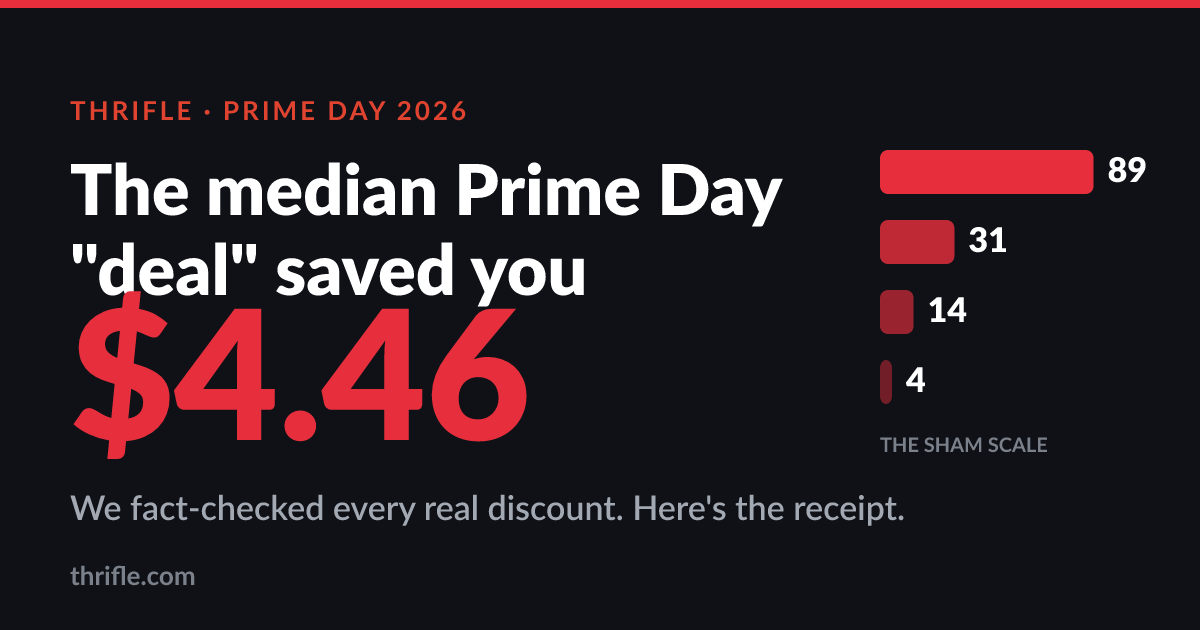
We checked. Every real discount we could track through Prime Day 2026, scored against what each product normally costs. And the median discount — the one right in the middle — saved shoppers $4.46.
Not nothing. But a long way from the fireworks in the ads. Here's the whole story — how we got here, the number that surprised even us, and a 60-second game to test whether you could've spotted the fakes.
Wait, back up — how did we end up counting lattes?
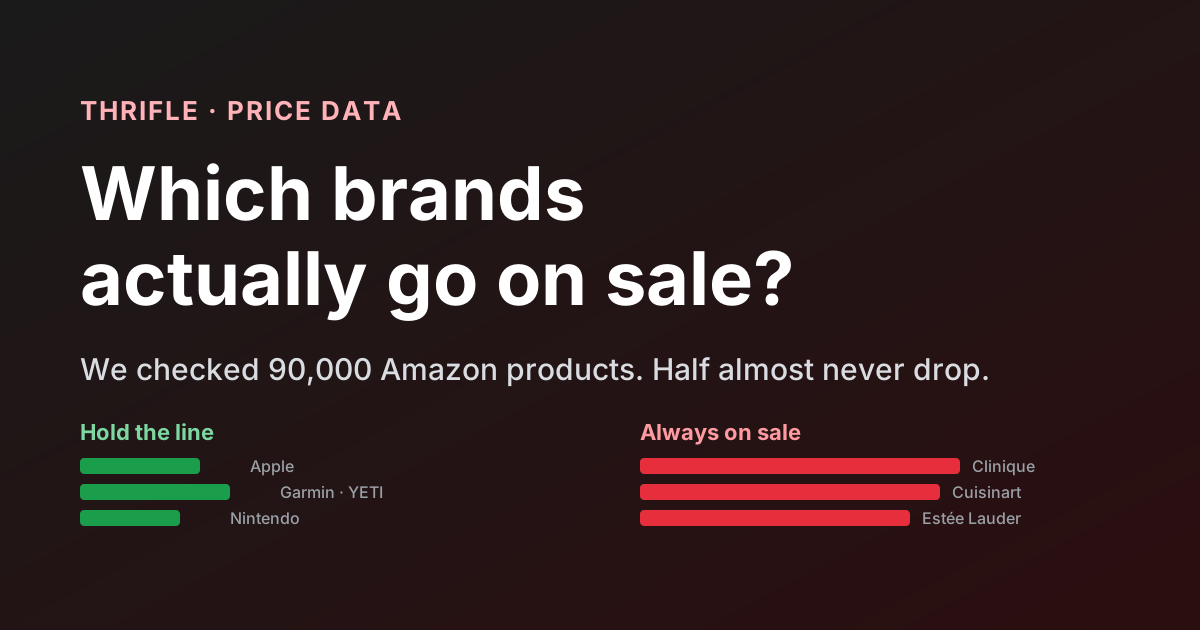
A couple of weeks ago we did a slightly obsessive thing. We pulled the real price history of tens of thousands of Amazon products and checked what actually happened to their prices during Prime Day. The short version, which we wrote up here (and in plainer English here): most of the store never went on sale at all. In part one, 76% of the products we checked didn't move a single cent.
It struck a nerve. And then a really sharp reader made a point we couldn't argue with: "You measured the whole store — but most of that was never claimed to be a deal. If you want to know whether the deals are real, study the deals."
Fair. Completely fair. So we did exactly that. This is that study. 👇
First: what even is a "deal"?
Turns out every argument about Prime Day is secretly an argument about this one slippery word. So we built a ladder, from loosest to strictest:
The deal ladder 🪜 (tap to fold)
- Marketed — everything under the Prime Day banner. Amazon's own words: "millions of member-exclusive deals," new ones "as often as every five minutes."
- Promoted — deals actually put in front of you: Amazon's featured lists, big press roundups.
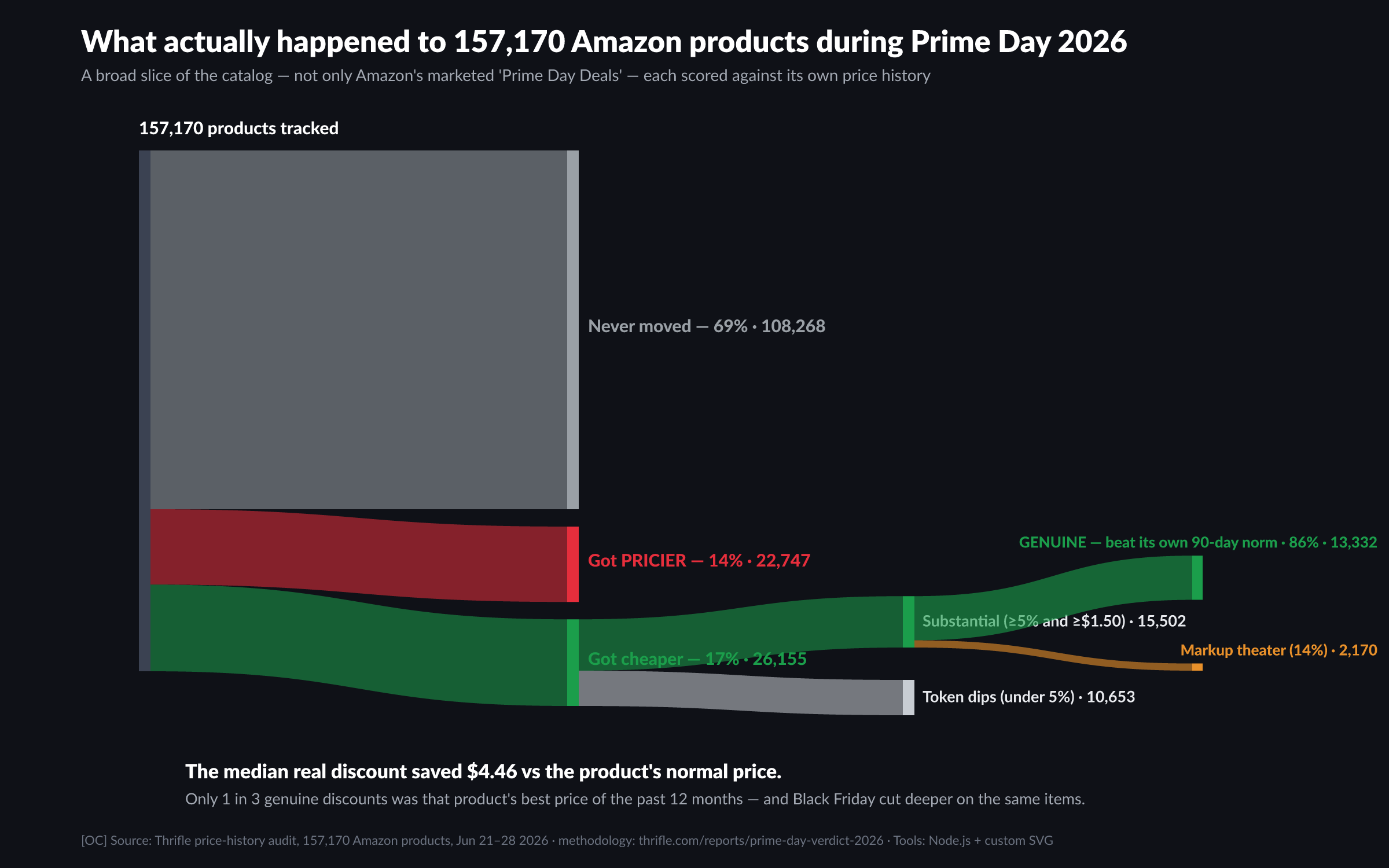
- Priced — stuff that genuinely got cheaper, by any amount. About 1 in 6 products.
- Substantial — at least 5% and $1.50 off (a low bar, on purpose).
- Genuine — the sale price actually beat the product's own normal price.
- Best-of-year — a true 12-month low. The holy grail.
The higher you climb, the fewer products qualify — and the more honest they get. To measure that, we scored the event at four of those levels. We call it the Sham Scale (a word one of our readers handed us, and honestly, it stuck):
Read the bars top to bottom and the whole study is right there: the closer you get to a real, promoted deal, the more honest Prime Day becomes. The theater lives at the top — the vague "everything's on sale" halo — not in the deals people actually pointed you toward.
The discount you see vs. the discount you get
Here's the sleight of hand. A "$40 → $30" tag looks like $10 off. But if that thing sat at $31 all last month, you didn't save $10 — you saved a buck. So we measured both: the sticker cut (vs. the price right before the event) and the true cut (vs. the product's own 90-day normal).
Which is how the median lands at $4.46. And ~1 in 25 "deals" were actually more expensive than the item's normal price. Bold move, calling that a deal.
Plot twist: the deals they promoted were… actually good?
We went in bracing for a bloodbath. Instead — credit where it's due. When we scored only the 865 deals Amazon and the press actually put in front of shoppers, most were the real thing:
So if you shopped from a real list instead of just vibing through the app, you probably did fine. That said… a few fakes still snuck onto the fancy lists. Our favorites:
A "$5 off" sticker sitting above the product's 90-day average is the purest form of the art. 👏
Okay but was Prime Day even the best sale of the year?
lol. No.
On the exact same products, Black Friday cut deeper. And the real kicker: of every genuine Prime Day discount, only 33% was that product's best price of the past 12 months. The other 67% were beaten on some random Tuesday nobody was watching. Patience remains undefeated.
One more, for the data nerds (hi 👋)
Amazon has an official, auditable deal format — Lightning Deals, the ones with countdown timers. They leave a fingerprint you can check after the fact. So we did, across every single product that dropped in price. The result: only 1 in 258 real discounts carried that official flag. Which means ~99.6% of Prime Day's actual discounting happened with no official label at all — no badge, no receipt, no way to verify it later. The "Prime Day Deal" badge itself? It isn't published anywhere and vanishes when the event ends. Nobody outside Amazon can check it — which is exactly why a tool that checks a price against its own history has to exist.
So… should you even shop Prime Day?
Sure — just don't trust the countdown timer, trust the price history. Real deals exist; they're maybe 8% of the store, and they're findable. The trick is checking any price against what that specific product normally costs. Which, conveniently, takes about three seconds:
We turned five real Prime Day products into a game — some deals genuine, some pure theater. Most people miss at least two.
Play "Real Deal or Theater?" →Paste any Amazon link and see if the price is actually low for that product — free, no account.
Check a price →How we did this: we tracked Amazon products with full price history across the June 21–28 window (our own dataset — not all of Amazon, so there were deals we didn't see), plus 865 deals recovered from Amazon's featured lists, major press roundups, and community threads. "Genuine" means the deal price beat the product's own 90-day average. Full method, limits, and the interactive version live in the full report.
Straight up: Thrifle is an Amazon affiliate — links here may earn us a commission. We're not here to bash Amazon; we're just an impartial layer of truth between shoppers and the stores they buy from. Which is why we published the number that makes Amazon look good (87% of promoted deals were real) right alongside the rest. The data says what it says.