The Prime Day Verdict: we audited every real discount we could find
Part one asked whether the store was really on sale (mostly: no — 76% of products never moved). This one asks the question readers rightly pushed us on: fine — but how good were the actual deals?So we audited every real discount against that product's own price history. Here's the verdict — and you can check our work on any product, live, below.
First: what even counts as a "deal"?
Amazon describes the event, in its own words, as "millions of member-exclusive deals worldwide," with new deals dropping "as often as every five minutes" (aboutamazon.com). Both that claim and ours can be true at once — millions of deals, across a store of hundreds of millions of listings, still leaves most of the store untouched. Every argument about Prime Day is secretly an argument about this word. So here's the ladder we use — and every number on this page tells you which rung it lives on:
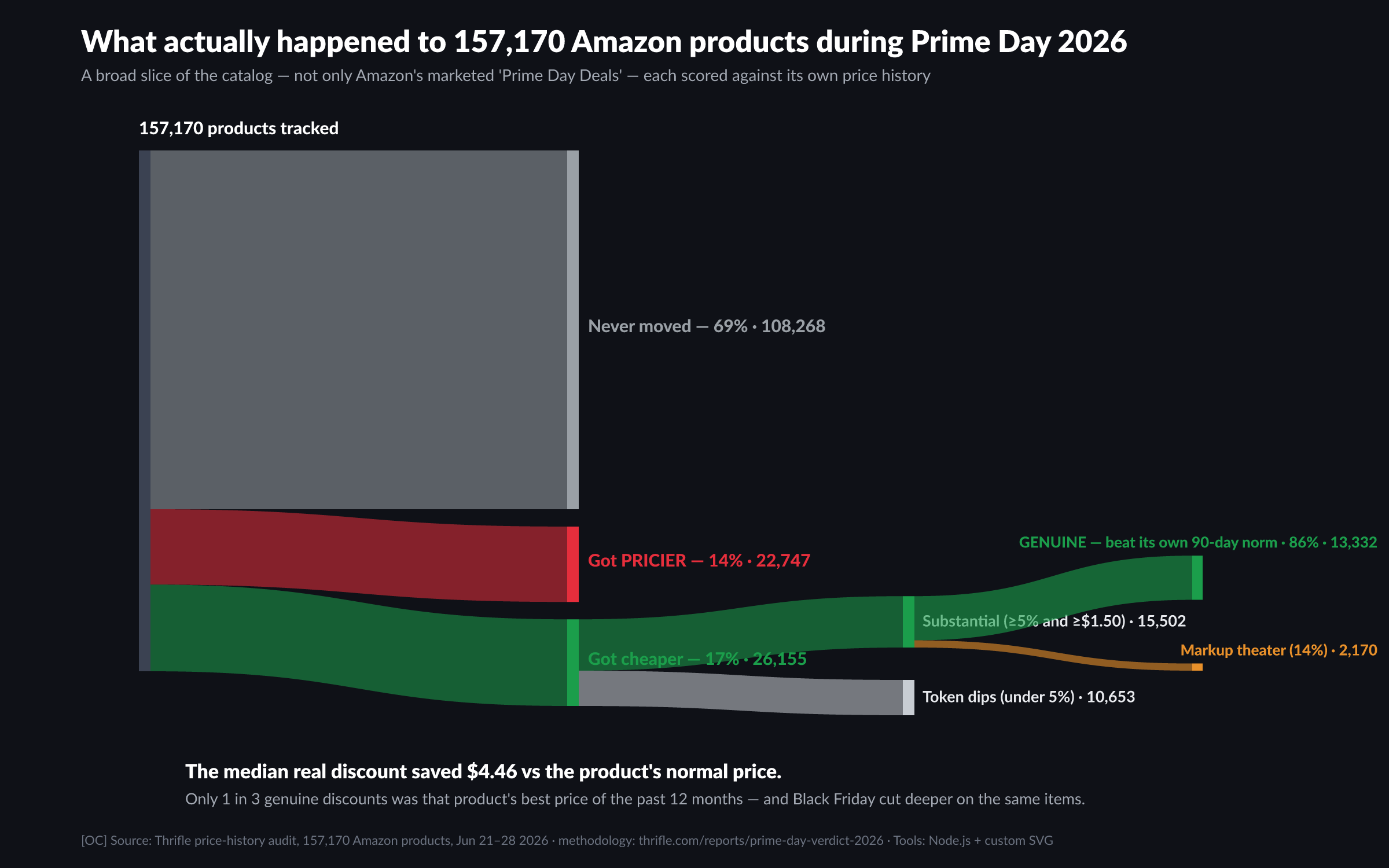
- Marketed — everything under the Prime Day banner. 157,170 products we tracked through the event
- Promoted — explicitly pitched to shoppers: Amazon's featured lists, press roundups, community threads. 865 recovered and scored
- Priced — actually got cheaper during the event, by any amount. 26,155 (~17% of the store)
- Substantial — at least 5% and $1.50 off. 15,502
- Genuine — the deal price beat the product's own 90-day norm. 86% of substantial deals cleared this bar
- Best-of-year — a true 12-month low. only 33% of genuine deals
A note on rung 4, because we'd rather you check us than trust us: 5% + $1.50 is a deliberately low bar. Both conditions must hold — so a 50¢ dip on a $10 gadget doesn't count, and neither does $1.50 off a $600 TV. We set it conservatively so no real discount gets excluded; for context, deals featured on Thrifle typically run 20%+ off. If anything, this bar flatters Prime Day.
Play it: real deal or theater?
Five real products from the audit. Each showed a Prime Day discount. Some were genuine; some just walked back a markup nobody noticed. Would you have caught them?
What shoppers actually saved
There are two ways to measure a discount: the sticker cut (against the pre-event price Amazon anchors you on) and the true cut (against the product's own 90-day norm — what you saved versus just buying it on a random Tuesday).
| Sticker discount | True discount | True savings | "Deal" but paid ≥ normal | |
|---|---|---|---|---|
| Typical substantial deal n=15,502 | 16% | 14% | $4.46 | 4.2% |
| Promoted deal n=117 | 21% | 19% | $24.17 | 0.9% |
Read the savings column again: the median real Prime Day discount saved $4.46. Not nothing! But a long way from the fireworks in the ads. The deals actually promoted to you did far better — $24.17 median true savings — which brings us to the most surprising thing we found.
The deals they told you to buy
We recovered 865 deals as they were actually pitched to shoppers — from Amazon's own featured lists, major press roundups, and community deal threads — and scored each one against its own price history. The result genuinely surprised us:
Credit where due: the curation mostly worked. If you shopped from Amazon's featured list or a major roundup, the deal in front of you was usually real — and worth several times the event's typical discount in dollar terms. The theater that did sneak into promoted lists is instructive, though. A few we caught:
A "$5 off" sticker next to a 90-day average that's lower than the deal price — that's the tell. Every product above links to its full price history. Check us.
The accountability gap
Now the nerdy finding we can't stop thinking about. Amazon has an official, auditable deal format — Lightning Deals and Deal of the Day, the ones with countdown timers. Those leave a verifiable fingerprint after the event ends. So we checked every one of the 26,046 products that actually dropped in price. This is a census, not a sample:
99.6% of the event's actual discounting happened off the books — ordinary price movements with no official flag, no recorded start or end, and no way for a shopper to verify anything after the fact. The regular "Prime Day Deal" badge? During the event it's unmistakable — the category cards, the red pill on each listing. But Amazon never publishes that list and it vanishes the moment the event ends, so after the fact nobody outside Amazon can reconstruct exactly which items carried it. Keep that in mind when you read any study of "Prime Day deals" — including ours. It's also why, at Amazon's October event, we'll be watching the badges live — so the next version of this study can audit them in real time.
Check what you actually bought
Paste any Amazon product — your Prime Day haul, your cart, anything — and see whether its price is genuinely low for that product.
Was Prime Day even the best sale of the year?
Same products, every major sale window of the past 12 months. Median depth of real discounts:
No — Black Friday cut deeper. And the sharpest cut of all: of every genuine Prime Day discount, only 33% was that product's best price of the past 12 months. The other 67% were beaten on some ordinary day nobody was watching. Patience, it turns out, is the best deal-hunting strategy ever invented.
Your category's report card
Methodology, honestly
Population. 157,170 products with price history covering June 21–28, 2026, from our price-tracking database — a large tracked slice of the store, not a census of Amazon; deals outside our dataset are not counted — plus 865 promoted deals recovered from Amazon's featured lists, major press roundups, and community threads, each tagged with its source.
Baselines. A drop is measured against the price in effect June 21. "Genuine" means the deal price beat the product's own 90-day average by at least 5%. We also test a 1-month baseline (median daily price May 23–June 21) to catch markups that started early.
Thresholds are conservative on purpose. "Substantial" = at least 5% and at least $1.50 off — both conditions, so a 50¢ dip on a $10 item doesn't count, and neither does $1.50 off a $600 one. That bar is deliberately low (deals featured on Thrifle typically run 20%+ off); a stricter bar would make Prime Day look worse, not better.
The Sham Scale™. At each rung of the deal ladder: the share of items whose "deal" did NOT beat the product's own 90-day norm. Prime Day 2026: whole store 89 · looked-discounted 31 · substantial 14 · promoted 4. We'll recompute it for every major sale event, starting with Amazon's October event.
Limitations — read these, they matter. (1) Deals that started before June 21 can read as "no change" in our window, so participation shares are floors, not ceilings. (2) Prime Day Deals are badged on-site during the event (category cards + the red pill) — but Amazon doesn't publish that list and it vanishes at event end, so it can't be reconstructed retroactively from price history; our flagged-deal census covers the formats that DO leave a durable trace (Lightning / Deal of the Day). Capturing the badges properly means logging them live, which is the October plan. (3) Very short deals can slip between price samples. (4) Our catalog is seeded from best-seller lists — broad, but not a census of all of Amazon. (5) The analysis uses commercial price-history records as observed; prices personalized to individual shoppers aren't visible to anyone outside Amazon.
Disclosure & independence. Thrifle participates in Amazon's affiliate program — purchases through our links may earn us a commission. We're not here to bash Amazon: we exist to be an impartial layer of truth between shoppers and stores, and we publish what the data says either way. This page reports both the theater and the fact that 87% of the deals Amazon promoted were genuine.
Per-product data (baselines, event lows, flags, provenance): the Prime Day 2026 dataset — a paid download, which funds this research. Questions or press: contact us.
The verdict
Big discounts are mostly honest. Small discounts are mostly theater. And most of the store was never discounted at all. That one sentence is the whole study.
- In this pool, 69% of products never moved and 14% got pricier (part one, on its own frozen set: 76% flat). The event's marketing covers the store; its pricing doesn't. (Sham Scale: 89 at store level.)
- Of real, substantial discounts, 86% were genuine — and the median one saved you $4.46 versus a normal day.
- The deals Amazon and the press promoted were the real thing: ~87% genuine, ~$24.17 median true savings. The curation worked.
- But 99.6% of the event's real discounting carried no official flag — unlabeled, unauditable price movement. That's the accountability gap, and it's why tools that check a price against its own history need to exist.
- Black Friday cut deeper than Prime Day on the same products, and two-thirds of Prime Day's genuine discounts were beaten at some other point in the year. The best day to buy is usually "the day it happens to be cheap."
The one-liner for the group chat: Prime Day is real — it's roughly 8% of the store, and the rest is set dressing. Check any product against its own history at thrifle.com/price-predict — and we'll see you in October, watching the badges live.